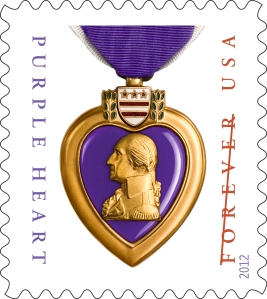
The release of the new Purple Heart Medal Forever® stamp last week had us wondering about the history of this distinctive honor. Did you know that this military decoration dates as far back as George Washington?
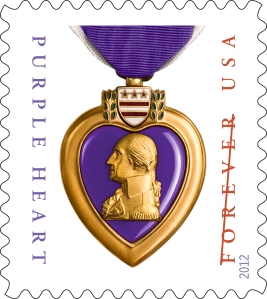 On August 7, 1782, during the Revolutionary War, General Washington issued an order that established a badge of distinction for meritorious action. The badge, which consisted of a heart made of purple cloth, is known to have been awarded to three sergeants from Connecticut regiments. Known as the Badge of Military Merit, the award was distinctive because it was available to the lower ranks at a time when only officers were eligible for decoration in European armies. “The road to glory in a patriot army,” Washington wrote, “is thus open to all.”
Although not continued after the Revolutionary War, the decoration was reinstated by the U.S. War Department (now the Department of Defense) on February 22, 1932, the 200th anniversary of Washington’s birth. The redesigned decoration consists of a purple heart of metal bordered by gold, suspended from a purple and white ribbon. In the center of the medal is a profile bust of George Washington beneath his family coat of arms.
This First Day Cover bears an affixed stamp and an official First Day of Issue postmark. (Click image to order.)
Since World War II, U.S. presidents periodically expanded the eligibility requirements for the Purple Heart. On December 3, 1942, President Franklin D. Roosevelt issued an executive order extending the award to the Navy, Marines, and Coast Guard and making the change retroactive to December 6, 1941. President Harry S. Truman later extended the date of eligibility retroactively to April 5, 1917, to include those who were injured or killed during World War I.
From 1962 to 1998, civilian personnel wounded or killed while serving under military command were also eligible for the Purple Heart, in accordance with a 1962 executive order by President John F. Kennedy. That order also prompted a policy change to include prisoners of war wounded during captivity. (A 1996 law authorized awarding the Purple Heart to POWs wounded before April 25, 1962.) Kennedy’s 1962 executive order was amended in 1984 by President Ronald Reagan to include both military personnel and civilians under military authority who were killed or wounded in an international terrorist attack after March 28, 1973.
A law that went into effect in 1998 restored the previous criteria so that today only members of the U.S. armed forces may receive the Purple Heart. The Defense of Freedom Medal, the civilian equivalent of the Purple Heart, was unveiled by Secretary of Defense Donald H. Rumsfeld on September 27, 2001.
The Purple Heart Medal Forever® stamp is now available online and in Post Offices nationwide.


 Rubin, a native of the Bronx, New York, began his military service with the U.S. Army in May 1943. Injured twice in July 1944 during military operations in the Normandy region of France, Rubin was awarded a Purple Heart and an Oak Leaf Cluster to the Purple Heart. On July 8, 1944, for gallantry in action during a fierce German counter-attack, he received a Silver Star. In February 1946, Rubin returned to civilian life. Upon his death in December 1978, Rubin was buried at Arlington National Cemetery with full military honors.


