Purple Heart Stamps Tell Personal Stories

2003 stamp

The U.S. Postal Service issued its first Purple Heart stamp in 2003. That stamp featured a photograph, taken by Ira Wexler, of a Purple Heart awarded to Lt. Col. James Loftus Fowler (USMC) in 1968 following an action on the border between North and South Vietnam.

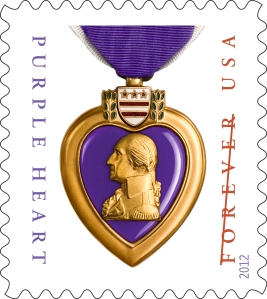
The 2012 Purple Heart Medal Forever® stamp features a photograph also taken by Wexler of the decoration awarded during World War II to 1st Lt. Arthur J. Rubin (1917–1978).

Rubin, a native of the Bronx, New York, began his military service with the U.S. Army in May 1943. Injured twice in July 1944 during military operations in the Normandy region of France, Rubin was awarded a Purple Heart and an Oak Leaf Cluster to the Purple Heart. On July 8, 1944, for gallantry in action during a fierce German counter-attack, he received a Silver Star. In February 1946, Rubin returned to civilian life. Upon his death in December 1978, Rubin was buried at Arlington National Cemetery with full military honors.

Revolutionary History of the Purple Heart Medal

The release of the new Purple Heart Medal Forever® stamp last week had us wondering about the history of this distinctive honor. Did you know that this military decoration dates as far back as George Washington?

On August 7, 1782, during the Revolutionary War, General Washington issued an order that established a badge of distinction for meritorious action. The badge, which consisted of a heart made of purple cloth, is known to have been awarded to three sergeants from Connecticut regiments. Known as the Badge of Military Merit, the award was distinctive because it was available to the lower ranks at a time when only officers were eligible for decoration in European armies. “The road to glory in a patriot army,” Washington wrote, “is thus open to all.”

Although not continued after the Revolutionary War, the decoration was reinstated by the U.S. War Department (now the Department of Defense) on February 22, 1932, the 200th anniversary of Washington’s birth. The redesigned decoration consists of a purple heart of metal bordered by gold, suspended from a purple and white ribbon. In the center of the medal is a profile bust of George Washington beneath his family coat of arms.

This First Day Cover bears an affixed stamp and an official First Day of Issue postmark. (Click image to order.)

Since World War II, U.S. presidents periodically expanded the eligibility requirements for the Purple Heart. On December 3, 1942, President Franklin D. Roosevelt issued an executive order extending the award to the Navy, Marines, and Coast Guard and making the change retroactive to December 6, 1941. President Harry S. Truman later extended the date of eligibility retroactively to April 5, 1917, to include those who were injured or killed during World War I.

From 1962 to 1998, civilian personnel wounded or killed while serving under military command were also eligible for the Purple Heart, in accordance with a 1962 executive order by President John F. Kennedy. That order also prompted a policy change to include prisoners of war wounded during captivity. (A 1996 law authorized awarding the Purple Heart to POWs wounded before April 25, 1962.) Kennedy’s 1962 executive order was amended in 1984 by President Ronald Reagan to include both military personnel and civilians under military authority who were killed or wounded in an international terrorist attack after March 28, 1973.

A law that went into effect in 1998 restored the previous criteria so that today only members of the U.S. armed forces may receive the Purple Heart. The Defense of Freedom Medal, the civilian equivalent of the Purple Heart, was unveiled by Secretary of Defense Donald H. Rumsfeld on September 27, 2001.

The Purple Heart Medal Forever® stamp is now available online and in Post Offices nationwide.

How the President Rides

Designated commander-in-chief of the nation’s armed forces, the President of the United States relies on military personnel for safe travel. Both the Air Force and Marine Corps are responsible for the President’s transportation, whether on international flights, or short trips around Washington, D.C.

Although the name Air Force One suggests that only one aircraft transports the President throughout the nation and the world, in fact the current presidential fleet consists of two nearly identical and specially configured 747-200B series planes put into service in 1990. These planes—VC-25A aircraft with tail numbers 28000 and 29000—are maintained and operated by the Presidential Airlift Group and based just outside the nation’s capital at Andrews Air Force Base in Camp Springs, Maryland. When the President is aboard either aircraft, or any other Air Force aircraft, the radio call signal for that plane is “Air Force One.”

Probably the most famous jetliner in the world, Air Force One looks like any commercial jumbo jet except for its distinctive exterior. Painted shades of blue and white, the plane’s design—by noted industrial designer Raymond Loewy—includes the U.S. flag painted on the tail, the words “United States of America” emblazoned on the fuselage, and the Presidential Seal. Inside, it is clear that this is no ordinary plane. In addition to private quarters for the President and First Lady, there are two galleys where food is prepared, a conference/dining room, office space for senior staff members, and work and rest areas for the presidential staff, Air Force crews, and media representatives traveling with the President.

Although the call sign “Air Force One” has been used to designate the President’s plane since the 1950s, it was President Kennedy’s 707 that became known to the nation and the world as “Air Force One” in 1963 at the time of his assassination. In 1972, President Richard M. Nixon made historic visits to the People’s Republic of China and the Soviet Union aboard this plane, which today is on display at the U.S. Air Force Museum at Wright-Patterson AFB near Dayton, Ohio.

Often photographed on the South Lawn at the White House, Marine One not only transports the President on short trips—for example, from the White House to Andrews Air Force Base to board Air Force One and on visits to Camp David—but regularly accompanies the President on nationwide and worldwide travel. Wherever Marine One might be, it is always met on the ground by at least one Marine in full dress uniform. As with Air Force One, “Marine One” is the radio call sign for the U.S. Marine Corps helicopter (or any other aircraft belonging to the Marine Corps) that transports the President.

Marine Helicopter Squadron One, HMX-1, was established in 1947 as an experimental unit to test and evaluate helicopters. Today this squadron and its fleet of 19 helicopters provide all helicopter transport for the President, the Vice President, and members of the Cabinet. The unit also provides helicopter emergency evacuation and other support as directed by the Commandant of the Marine Corps. More than 800 Marines supervise the operation of the fleet, which is based in Quantico, Virginia.

In 1957 President Dwight D. Eisenhower became the first president to fly in a helicopter—a single-engine, 3-passenger craft. Today’s Marine One is a twin-engine, 8-passenger craft.

Issued in 2007, these Priority Mail and Express Mail stamps honor some of the country’s most important military vehicles. Noted aviation artist William S. Phillips created the images for both stamps, capturing the President’s plane and helicopter in iconic positions.

What other sorts of important military vehicles would you like to see on future stamps?

Four Marine Legends Distinguished for Bravery and Heroism

In 2005, the Postal Service issued four Distinguished Marines stamps, honoring a tradition of excellence in military service that began with the establishment of the first two battalions of the Marine Corps by the Continental Congress in 1775. These four legendary Marines served with bravery and distinction during the 20th century, galvanizing their places in American history.

Famous for his heroism during World War II, John Basilone (1916-1945) was a Congressional Medal of Honor recipient whose name and reputation are synonymous with the sacrifices and sense of duty shared by generations of enlisted Marines.

Basilone enlisted in the Marine Corps in July 1940. In October 1942, while serving as a sergeant with the 1st Battalion, 7th Marine Regiment, 1st Marine Division at Guadalcanal in the Solomon Islands, he was in charge of two sections of heavy machine guns during a fierce assault by a Japanese regiment. With one of his gun crews out of action, he helped repel and defeat the Japanese forces. Following the grueling battle, Basilone was awarded the Congressional Medal of Honor “for extraordinary heroism and conspicuous gallantry in action against enemy forces, above and beyond the call of duty.”

As a gunnery sergeant he participated in the invasion of Iwo Jima with the 1st Battalion, 27th Marines, 5th Marine Division. After distinguishing himself by single-handedly destroying an enemy blockhouse and helping to guide a friendly tank out of a minefield, he was killed in action there on February 19, 1945, at the age of 28. For his heroism at Iwo Jima, Basilone was posthumously awarded the Navy Cross.

A highly decorated Marine, Daniel J. Daly (1873-1937) was one of only two Marines to be awarded two Medals of Honor for separate acts of heroism.

In 1900,  Daly was sent to China, where he earned his first Medal of Honor after defending the American legation during the Boxer Rebellion, fighting off attackers while a barricade was repaired. In 1915 he was sent to Haiti, where he earned his second Medal of Honor for helping to defend 38 Marines against approximately 400 bandits.

Daly is best remembered for rallying his men at Belleau Wood in June 1918 during a bleak moment when they were facing heavy German machine-gun fire. For his bravery in 1918, he was awarded the Distinguished Service Cross, and he received prominent decorations from the French government as well, including the Croix de Guerre with Palm.

John A. Lejeune (1867-1942) is remembered for his professionalism and dedication. Lejeune is often referred to as “the greatest of all leathernecks,” and his leadership and foresight helped prepare the Marine Corps for the amphibious assaults of World War II.

During World War I, Lejeune led the 64th Army Brigade and the 4th Marine Brigade. Beginning in July 1918, he was promoted to major general and became the first Marine to command an Army division. For his service, Lejeune was awarded the Distinguished Service Medal from both the Army and the Navy; the French Legion of Honor; and the Croix de Guerre with Palm.

From 1920 until 1929, while serving as Commandant, Lejeune was determined to keep the Marine Corps from becoming antiquated. He foresaw the need for specialized amphibious assault capabilities, and his efforts prepared the Marine Corps for island invasions in the Pacific during World War II. Today, in keeping with an order issued by Lejeune in 1921, an annual message that summarizes the history, mission, and traditions of the Marine Corps is published each November during the Marine Corps birthday celebration.

Nicknamed “Chesty” for his physique as well as for his aggressive bearing, Lewis B. Puller (1898-1971) had a reputation for incredible toughness. Renowned for his leadership during crucial battles in World War II and the Korean War, Puller became one of the most highly decorated Marines, rising through the ranks from private to general and receiving the Navy Cross five times.

Between 1928 and 1933 Puller fought in Nicaragua, where he earned his first two Navy Crosses. He then served for nearly two years at the American legation in China, where his duties included command of the famous Horse Marines. In 1942, after training the 1st Marine Battalion, 7th Marine Regiment, 1st Marine Division, he led them through fierce combat against the Japanese at Guadalcanal, where the Marines’ defense of the airstrip at Henderson Field earned Puller his third Navy Cross. In late 1943 and early 1944, the 7th Marines also took part in the invasion of the island of New Britain, where Puller received his fourth Navy Cross following combat at Cape Gloucester.

During the Korean War, Puller again commanded the 1st Marines during the risky U.S. landing at Inchon in 1950. For his service in Korea, Puller earned his fifth Navy Cross and a promotion to brigadier general. Puller retired as a lieutenant general in 1955 and died in 1971.

Behind these highly distinguished men stand millions of other servicemen and servicewomen who have dedicated their lives to protecting our country. We thank them all for their sacrifices.

Armed Forces Utilize the Strength, Agility of American Aviation

Advances in aviation since the Wright brothers’ first airplane flight in 1903 have had a significant impact on our country’s military power. Issued in 1997, the Classic American Aircraft pane features 20 planes representing the first 50 years of powered flight in America, many of which were instrumental in times of conflict.

Grumman’s F4F was the Navy’s first line of defense in early World War II. It out-fought the faster, more agile Japanese Zero at the Coral Sea, Midway, and Guadalcanal. The Wildcat’s rugged service continued throughout the war.

An early 1930s breakthrough, this sleek monoplane took over the job of bomber from big, slow biplanes. The Martin B-10 carried a one-ton cargo, opened the eyes of strategists, and pointed the way to the hardy B-17 and B-24.

The bent-winged F4U achieved one of World War II’s highest victory ratios. Impressive in ground support, the Vought Corsair also served effectively in Korea. The plane was retired in the 1970s with a long and distinguished international record.

The Boeing B-17 is an American legend. In World War II, it carried the air war to Germany, bombing heavily defended targets while dodging flak and enemy fighters. Able to withstand severe damage, the ‘Fort’ commanded great respect.

Beautiful, agile, powerful, the North American P-51 is rated by many as the best fighter of WWII. The Mustang escorted bombers over Europe and the Pacific, sweeping the skies, and winning the hearts of its pilots.

These classic machines paved the way for countless advances in aviation technology, keeping American armed forces on the cutting edge. What kinds of aircraft would you like to see on a future stamp?